


Hello there Grocery Geeks,
Today we’ve got a long newsletter so I’m just going to get right to it. Read on to learn more about:
A potentially controversial comeback
Questionable claims
Recalls that reveal the messy side of the food business
After ByHeart’s Botulism Crisis, Its Founders Are Going Bigger
The executive team behind ByHeart, the formula company involved in last year’s botulism outbreak, is back in the baby business, with the announcement of MeridianMade’s acquisition of Perrigo’s (very large) infant formula business.
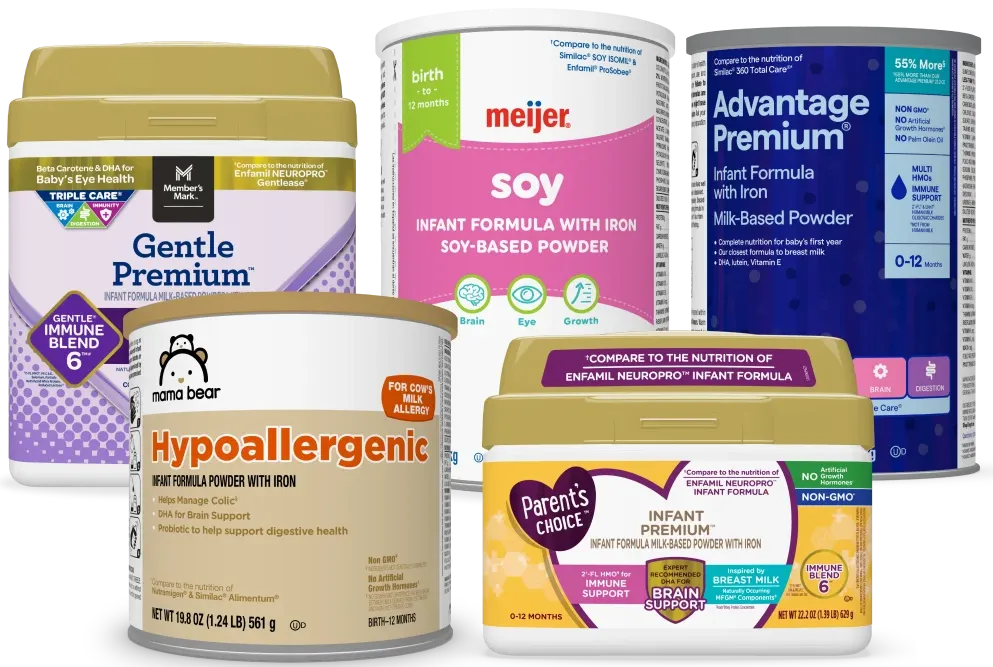
MeridianMade, founded by ByHeart’s former founders and siblings Ron Belldegrun and Mia Funt, will acquire the third-largest infant formula producer in the U.S. and Canada for up to 175 million, of which 40M is in cash and $135M is contingent on performance milestones. The deal is expected to close in 2027. You may not recognize the company name as while it has a branded product line, Perrigo mainly produces private label formulas for Target, Costco, Amazon, Walgreens, CVS, Kroger, and other brands.
What’s particularly eyebrow raising about this deal is Belldegrun and Funt themselves, with ByHeart linked to a 2025 botulism outbreak that sickened over 45 children. Not only are they leading the reigns at MeridianMade, as CEO and President, respectively, but they’ve brought the ByHeart crew on over as well with ByHeart’s Chief Quality Officer, Chief Medical Officer & Scientific Officer, Chief Business & Legal Officer and Chief Operating Officer all also joining MeridianMade.
A July SEC filing shows MeridianMade has more than $20 million in funding, and many of ByHeart’s former board members and investors are listed in the paperwork. ByHeart itself raised over $390 million from investors, including CPG backers AF Ventures, Red Sea Ventures, and several tech and healthcare funds.
Not only was this a large botulism outbreak, but it also was the first documented outbreak of botulism in the U.S. linked to contaminated formula since the condition was identified over fifty years ago. Now it’s true that regulators don’t yet have a full understanding of exactly where contamination occurred and the investigation seems to indicate an issue with the ingredient supply chain, not at the plant itself. That said, the FDA has said it “expects the infant formula industry to know its suppliers, enforce its ingredient standards, and take proactive, verifiable steps to ensure that the ingredients entering its facilities do not introduce avoidable risk.”
How ByHeart handled the outbreak and investigation seemed to make public outrage even worse.
ByHeart had about 1% of the infant formula market. As more children got sick with botulism and ByHeart was the link, FDA regulators believed they had found the source. However, ByHeart first recalled only a few lots instead of all its products.
At the same time, ByHeart shared a video of Funt telling parents to stay calm, saying “there is no reason to believe that infant formula can cause botulism.” Big Oops there.
Even after botulism was found in a ByHeart sample, executives said that “testing from a previously opened can lacks scientific basis to establish causation.” They also pointed out that botulism exists in nature, “even on vegetables,” so it could have entered an open can.
When ByHeart finally did a full recall, they first allowed customers to only return only two cans of formula, no matter how many unopened cans they had.
After eventually offering full refunds, ByHeart told customers to try Nara Formula. But Nara used the same supplier linked to the botulism problem and later had to recall all its products.
There were more problems. Even if ByHeart didn’t cause the botulism outbreak, FDA inspectors found several issues at their plant in the past, including a leaking roof and over 2,000 dead insects.
The formula market is already fairly small with a limited number of players – previous supply chain and recalls have caused massive shortages on shelves. So while a ByHeart recall didn’t cause too much disruption, if issues arise with Perrigo we could see much larger reverberations. Furthermore, MeridianMade expresses on its website that it hopes to co-manufacture other brands, so even more products could eventually fall under its auspices.
IQBAR’s Brain-Boosting Claims Get Checked by NAD
After discussions, the National Advertising Division (NAD) and IQ Bar have reached an agreement surrounding claims the company makes about its Plant Protein Bars, the organization announced yesterday.
The National Advertising Division (NAD) and the National Advertising Review Board (NARB) were set up in 1971 as an “independent system of self-regulation designed to build consumer trust in advertising.” NAD, specifically, evaluates advertising after third-party challenges as well as through its own inquiries.
In this case, NAD appears to be the party challenging IQ Bar’s claims, both expressed and implied.
The expressed claims included (but were not limited to):
“Boost physical performance”
“Crafted with clean ingredients to fuel focus and steady energy”
“IQ Bar is designed with science-backed nutrients to keep your brain sharp, and your body fueled – no sugar crashes, just pure brain power”
Lion’s Mane – a natural nootropic mushroom extract that supports focus,
MCTs – unique fats that provide sustained mental energy
Finally, the NAD said, IQ Bar was making the unsubstantiated claim that “IQ Bars are better than competing snack bars by providing noticeable improvements in cognition, physical performance and strength.”
When NAD reviews claims, it checks if there is a “reasonable basis” for them. This includes looking at the type of claim, the benefit to consumers, what could happen if the claim is false, and how much expert research supports it. Health claims especially need scientific proof, and ingredient claims alone are not enough to support bigger claims about the product.
After talking with NAD and sharing scientific studies, IQ Bar agreed to stop using almost all of the disputed claims. NAD looked at the evidence for the claim “Superior brain and body nutrition” and found IQ Bar could not provide data showing its bars were better than others. NAD recommended dropping the claim, and IQ Bar agreed.
Miyoko’s Goes Quiet as Its Founder Speaks Out Following Recall
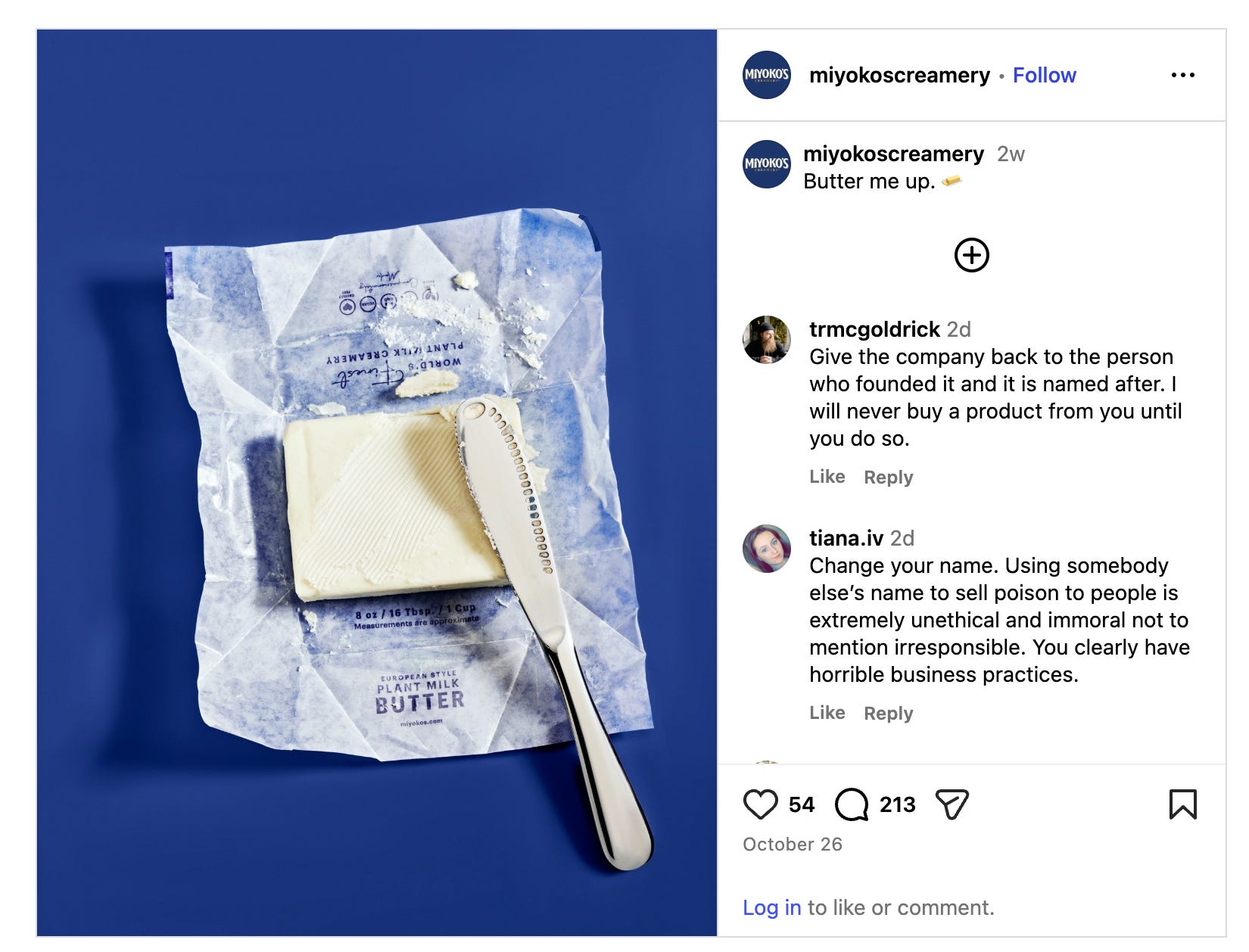
Vegan dairy brand Miyoko’s is once again in the limelight after its founder, author and animal advocate Miyoko Schinner has once again asked to get her company back following a recall. The brand, meanwhile, is silent.
If you don’t know Miyoko’s history, the TL;DR is that the company first went through a long dispute over the departure of founder and former CEO Schinner, with allegations from both sides of wrongdoings such as corporate theft and discrimination. It was later bought by Prosperity Organic Foods Inc. (makers of melt), even though Schinner said she tried to purchase the brand herself.
In late September, Miyoko’s reportedly contacted a few retailers to warn them about the “potential” for E. coli in its butter and asked them to remove the product from shelves. Some customers say they learned about this issue through retailer alerts as there was no public recall announcement. Then, in November the FDA posted an enforcement report for a class two recall “due to yeast, mold, and E. coli” for the same lots.
Maybe the circumstances changed—for example, it could be that the brand confirmed the presence of E. coli versus potential E. coli, but as the product may have lingered in customers’ refrigerators after retailers pulled it clearly something caused the company to go wider with the announcement. However, there was no company press release or social media post, rather other media publications picked up the announcement. The closest I found was a response to a commenter on Instagram.
“We voluntarily recalled a specific lot of European Style Salted Butter after testing identified a potential food-safety concern. The action is limited to the identified product and lot, and we worked with our retail partners and regulatory authorities to remove the affected product. We know how much people care about Miyoko’s and these products. We’re committed to earning that trust through transparency, product quality and what we put on shelves every day.”
Schinner took to Instagram after the recall, again pointing out she was no longer associated with the company and asking for the brand back.
So what does the brand say? Since October 26, the company hasn’t posted on Instagram. Meanwhile, consumers have been very vocal. As of today, that last post has over a hundred comments, with people telling the brand to change its name or return the company to Miyoko.
Honestly, it’s remarkable to see a founder with so much influence that even years after leaving, they still have many devoted fans asking for their return.
Understanding Once Upon a Farm’s Recall
Today, Once Upon a Farm announced its third quarter financial results and discussed its tractor wheels recall, telling shareholders and analysts on the call that the product line accounted for 18% of net sales and was “a meaningful contributor to growth.”
With so much food safety misinformation out there, I believe it’s important to help brands understand how the food system really works. So while there’s been a lot written about Once Upon a Farm’s recall, I want to highlight one interesting detail.
See, I first heard about the issue from an FDA advisory about Once Upon a Farm’s tractor wheels. Recalls are not unusual, but here’s the key point: the FDA issued the advisory. If you look at the timeline, the FDA tweeted about the advisory on Friday evening at 9:45 PM, while OUAF put out its press release around 10:30PM.
The FDA releases these advisories when it needs to quickly warn consumers about a health risk, and this doesn’t happen often. For example, the FDA issued only two other food advisories in 2026, four in 2025, and four in 2024 (three were about the cinnamon/applesauce lead issue). Compare that to the number of recalls each year. The reason you don’t see more of these? Well, if a company releases a recall in a timely manner, there’s no need to issue an advisory, experts told me.
The FDA alert now says, “The company has agreed to perform a recall,” but it first seemed to say, “The FDA has recommended that the company perform a recall.” I wondered if the advisory was issued before the FDA spoke to OUAF so maybe OUAF didn’t even have a chance to respond. However, in a call, CEO John Foraker said the FDA told the company about the issue on Thursday, more than 24 hours before the alert was released.
So what happened? It could be something as simple as OUAF asking for more time to evaluate the issue or maybe they didn’t want to issue a press release. The timing alone does not mean that Once Upon a Farm outright refused to recall the product. Instead, one food expert I spoke with (who had no involvement in this specific situation) said that threats of an FDA Advisory are often like a game of “chicken” with both parties waiting to see if the FDA will go through with the notice or if the company will give in and issue a recall.
Another point that’s slightly unusual is the FDA’s authority to issue this kind of advisory. Most advisories are about adulterated products, like undeclared allergens, harmful bacteria, or toxic elements such as lead. Certainly many foods can be choking hazards if eaten too quickly, but the ingredients seem to be in the right proportions here, with nothing extraneous added.
According to today’s call, the recall is projected to incur up to $30 million of costs.